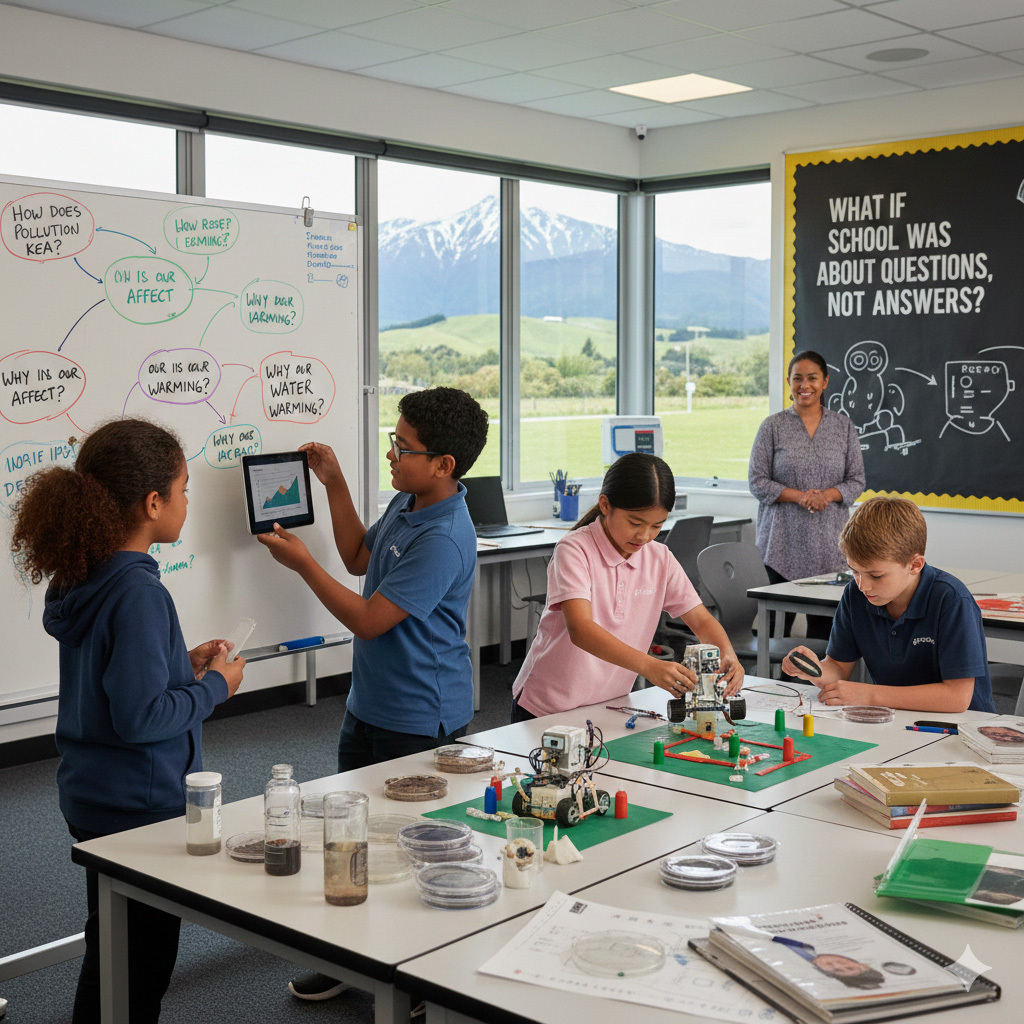
Questions build futures. Answers don’t.
Curiosity is the real curriculum.
Most classrooms still reward students for giving the right answer. But the future doesn’t ask for right answers — it asks better questions.
In today’s world, information is everywhere. What’s scarce is the ability to frame problems, interrogate evidence, collaborate, adapt and persist. These are not skills developed through rote learning. They are developed through inquiry.
Inquiry-based STEM learning starts with a simple but radical shift: students ask the questions.
Instead of being passive recipients of content, learners become investigators; designing experiments, testing ideas, refining thinking and learning how knowledge is constructed, not just consumed. Research consistently shows that inquiry-based approaches increase student engagement, agency and deeper understanding, particularly in science and mathematics.
Sir Ken Robinson warned that education systems too often “educate people out of their creative capacities.” When learning is reduced to compliance and recall, curiosity withers.
If we want young people prepared for uncertainty not just exams, we must value the quality of questions as much as the accuracy of answers.